
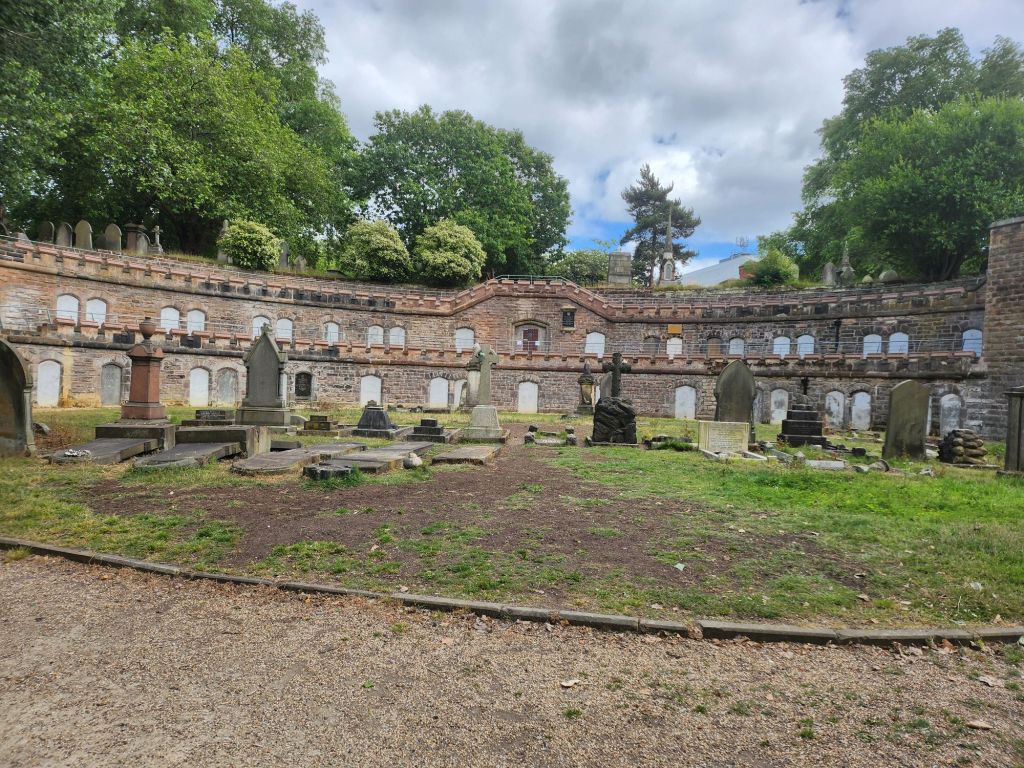
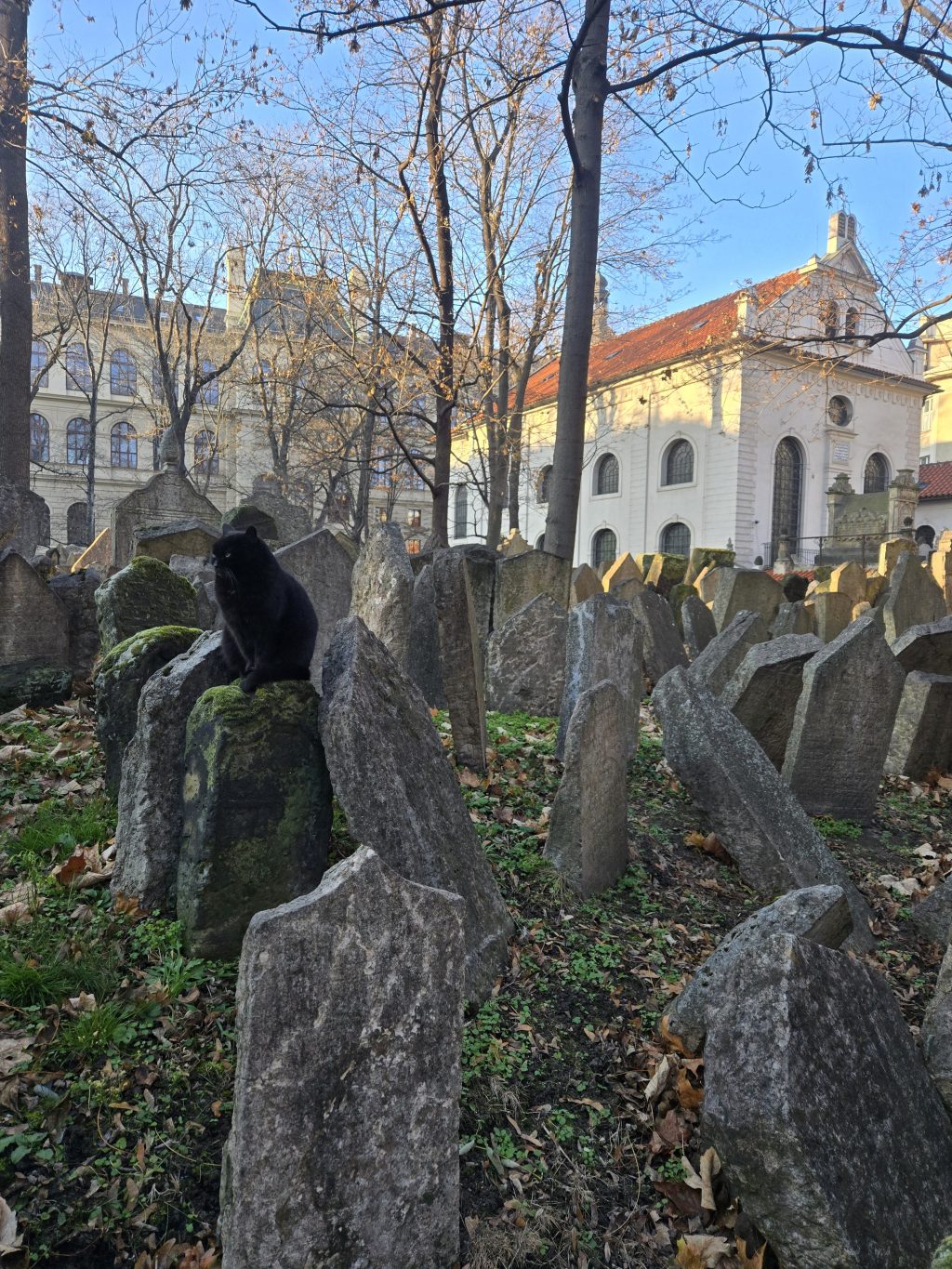
One of the most fascinating cemeteries I’ve been to for its history, its graves, and for how intelligent the responses were when I investigated here a lone last year.
One particular feature of the Cemetery is the War Stone – This felsite boulder was deposited near here by a glacier during the Ice Age; being at one time used as a parish boundary mark, it was known as the Hoar Stone of which the modern War stone is a corruption.”

The Druids Grave

A modern-day druid burial, which is rare to see in a church of England cemetery, the tomb reads
Erected to the Memory of
Bro. George William Manley P.P.G.A
Died July 11th 1935 Aged 90 Years
By the Ancient Order of Druids, Mercia No. 4
‘A Gentleman and a Druid’


The catacombs

The catacombs is rumoured to be haunted by both a female and male.
The female dressed in 1930’s attire has been seen many times, and has shocked onlookers by walking through walls and parked cars, even causing a moving car to screech to a halt only to smile at the driver and promptly disappear. Accompanying sightings of this lady, people claim to have noticed a smell of pear drops, which is what Arsenic is said to smell like after it has been swallowed. This dangerous substance was used in the jewellery quarter at one time, which leads people to believe that this lady was killed by arsenic poisoning.
A visitor claims to have spoken to a young man in an army style trench coat near the catacombs. During conversation, the young man referred to the Dudley Road Hospital as “The Infirmary”, a name not used for the hospital since 1948. When the witness walked away and turned to look again at the young man, he had disappeared.
I do wonder if the male seen here is of a man named John Bakerville…

When John Baskerville died in 1775, he was a very successful and wealthy man, but also a confirmed atheist. In his will, he provided strict instructions as to the treatment of his body.
Baskerville was not only buried upright, but in an air-tight lead-lined coffin.
Initially, these wishes were carried out, and Baskerville was interred in a small mausoleum in the grounds of his house Easy Hill. He rested here for many years.
However, in 1821, workmen digging for gravel disinterred Baskerville’s coffin, where it is subsequently laid unclaimed by relatives. As Baskerville was unwanted and an outspoken atheist, no cemetery would inter him, and his decayed body created somewhat of a quandary. For several years, it rested in the warehouse of Thomas Gibson, the man whose business stood in the place of the old Baskerville House.
Being an entrepreneurial sort, Gibson would occasionally open Baskerville’s coffin to curious visitors at the cost of 6d a peek. Oweing to Baskervilles’ method of burial, he was remarkably well preserved. A visitor, Thomas Underwood, sketched Baskerville’s body in August 1829 and recorded that –
“his body was, after forty-six years underground, in a singular state of preservation. It was wrapped in a white linen shroud with a branch of laurel, faded but firm in texture. The skin on the face was dry but perfect. The eyes were gone, but eye brows, the eye lashes, lips and teeth remained. The skin on the abdomen and body generally was in the same state with the face. An unpleasant smell strongly resembling decayed cheese arose from the body, and rendered it necessary to close the coffin quickly.”

Plumber John Marston soon found himself the new guardian of Baskerville and was decidedly less conscientious about opening the coffin. Soon, visitors to his corpse (oh yes, there were still visitors) were overcome by the smell of putrefaction and Baskerville had to go. At this stage, Baskerville’s state was less than pretty, but still, no-one would bury his remains. After a series of underhand machinations on the part of Marston, Baskerville was buried in the catacombs beneath Christ Church.
However, Baskerville was denied his rest once more when Christ Church was demolished in 1899, and he – along with 600 other internees – was finally laid to rest at Warstone.
His one wish of rejecting burial on consecrated ground was not to be. Today, his manhandled remains have the best view of the cemetery, which, although pleasant. No doubt would have provided no small comfort.



 Paranormal Hauntings
Leave a comment